The Centre has strongly defended the validity of section 3(d) of the Patents Act 1970 (in its present form) against Swiss-based Novartis which earlier challenged the constitutional validity of section 3(d). Additional Solicitor-General --- V.T. Gopalan at the Madras High Court told that the amended section 3(d) of the Patents Act and explanation provided therewith were valid and also contended that Section 3(d) along with explanations only prohibited camouflage inventions for the purpose of continuing in the patent regime, which invention had no enhanced efficacy. Mr. Gopalan said that (1) an invention with a mere change of form without any enhanced efficacy could not be granted patent and if patent was granted, it would be arbitrary and (2) the amended provision along with the explanation fully complied with Articles 7 and 8 of TRIPS. He further added that there were sufficient guidelines under the Statement of objects and reasons and other provisions of the legislation for exercise of power under the amended section. Hence, as such the amendment was not arbitrary. He also added that no mala fides could be attributed to Parliament. Submitting that discrimination meant manifestly arbitrary, he said there was nothing in the provision which could be said to be arbitrary. On the other hand, the amendment conformed to the people’s aspirations.
Mr. Gopalan also state that the amendment did not provide any ‘unguided power’ to patent controllers to reject applications for patents on the ground that they were not new inventions. A Division Bench, comprising Justice R. Balasubramanian and Justice Prabha Sridevan, is hearing petition filed by Novartis challenging the rejection of its application for patenting beta crystalline form of Imatinib Mesylate under the Section 3(d) of the Patents Act.
Friday, February 23, 2007
Wednesday, February 14, 2007
Topamax Patent Litigation: US Court favors Johnson & Johnson
District Judge Stanley Chesler of the US District Court for the District of New Jersey has ruled in the favor of Johnson & Johnson in an infringement suit over its U.S. Patent No. 4,513,006 (the ‘006 patent) for epilepsy drug Topamax, generically known as Topiramate and thus prohibiting Mylan to sell generic Topamax before expiry of the ‘006 patent. In October 2006, J&J also won a preliminary injunction against Mylan which got US FDA approval for its generic Topamax in September 2006. Mylan during court proceedings argued that the ‘006 patent on Topamax was invalid because its subject matter would have been “obvious” to a person having ordinary skill in the drug research. Judge Chesler, in his Feb. 02 ruling, said he found Mylan’s arguments unpersuasive. He said the generic drugmaker "has not presented even a theory of obviousness."
Saturday, February 10, 2007
Medtronic Loses Patent Lawsuit against BrainLAB
US Court of Appeals for the Federal Circuit has upheld the US District Court for the District of Colorado judgment to dismiss the patent infringement lawsuit filed by Medtronic against BrainLAB in 1998, affirming the district court ruling that BrainLAB image-guided surgery and radiotherapy products do no infringe any of the patents in suit (US Patent Nos. 4,722,056; 5,386,454; 5,389,101 and 5,603,318). In February 2006, the US District Court dismissed Medtronic’s patent infringement lawsuit, finding that BrainLAB products do not infringe any of Medtronic’s patents in suit. The district court concluded that a September 2005 jury verdict, where the jury found that BrainLAB infringed four patents held or licensed by Medtronic and awarded Medtronic US $ 51 million, was is error and not supported by the evidence.
QLT Settles Patent Dispute over Eligard
QLT has signed a settlement deal with TAP to settle a patent infringement suit between the companies, and will pay TAP US $ 112.5 million. The lawsuit was brought by TAP and its co-plaintiffs --- Takeda, Wako and Abbott in 2003 against QLT and co-defendant Sanofi-Synthelabo claiming that ALT infringed TAP’s patent through sales of QLT’s Eligard-brand products in the US and Canada. Also under the deal’s terms, co-defendant Sanofi will pay TAP US $ 45 million. Further, according to the settlement deal, TAP and its co-plaintiffs have granted to QLT a non-exclusive, perpetual, royalty-free license under their past and future patents to make, use and sell Eligard products in the US and Canada.
Sanofi Loses Lovenox Patent Lawsuit
It would not be wrong to quote that it would be a shock to world third largest drug maker – Sanofi-Aventis that the US District Court for the Central District of California has yet again invalidated its U.S. Reissue Patent No. RE38,743 (the ‘743 patent) on blockbuster blood thinner Lovenox, generically known as Enoxaparin Sodium which worth around $ 2 billion sales worldwide, after following Sanofi’s successful appeal in the US Court of Appeals which reversed the district court decision that had invalidated the ‘743 patent and returned back the case to the district court. The decision marks a major victory for generic manufactures --- Amphastar Pharmaceuticals Inc. and Teva Pharmaceutical Industries Ltd. which are being involved in legal fight since April 2003 following their Para IV challenge against the ‘743 patent.
Wednesday, February 07, 2007
After Repligen, Abbott Suing ImClone Systems for Erbitux

Abbott Laboratories has sued ImClone Systems alleging that ImClone’s Erbitux infringes Abbott’s patented method for creating antibodies. Abbott further added that the infringed patent covers “enhancer sequences” that stimulate the expression of a gene for the C225 antibody. Erbitux is used for the treatment of colon-cancer and last year generated U.S. sales of $ 652.2 million. However, a separate infringement lawsuit is pending in the U.S. District Court for the District of Massachusetts over a related U.S. Patent No. 4,663,281 (the ‘281 patent) brought by Repligen Corp. and the Massachusetts Institute of Technology on May 04, 2004. Repligen and MIT, in their complaint, alleged that ImClone’s production of Erbitux infringes the ‘281 patent covering certain genetic elements that increase protein production in a mammalian cell. The ‘281 patent is assigned to MIT and exclusivity licensed to Repligen. On July 28, 2006 the court issued a Summary Judgment ruling in favor of Repligen and MIT and rejected ImClone defense of patent exhaustion in the lawsuit. The Court found that neither the transfer to the National Cancer Institute (NCI) by Repligen’s predecessor (Damon Biotech) nor the subsequent transfer to ImClone by the NCI exhausted the proprietary rights of Repligen and MIT. The Court’s ruling eliminated patent exhaustion arguments as a potential defense for ImClone at trial.
Monday, February 05, 2007
Novartis received Indian Patent for Benflumetol derivatives
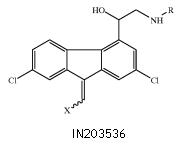
Novartis has received an Indian Patent Number 203536 (the ‘536 patent) titled Benflumetol derivatives against its patent application numbered IN/PCT/2000/884/CHE via PCT national phase. The ‘536 patent is directed to compound of formula I claiming priority from Swiss Patent Application No. 1351/98 dated June 25, 1998. The ‘536 patent is a mail-box application filed under section 5(2) of the Patents Act, 1970 which was later deleted by the Patents (Amendment) Act, 2005. The application for the ‘536 patent entered Indian national phase via International Application No. PCT/EP1999/004355 filed June 23, 1999 and published as WO1999/067197 dated December 29, 1999. The ‘536 patent is Indian equivalent of the U.S. Patent No. 6,329,552.
Merckle receives Indian Patent for 4-Pyridyl-and 2, 4-pyrimidinyl-substituted pyrrole derivatives

German MNC --- Merckle GmbH has recently received an Indian Patent Number 203540 (the ‘540 patent) titled “4-Pyridyl-and 2, 4-pyrimidinyl-substituted pyrrole derivatives and their use in pharmacy against the Indian application number IN/PCT/2002/1337/CHE. The ‘540 patent is directed to a 4-pyridyl- or 2, 4-pyrimidinyl-substituted compound of formula I and the optical isomers, physiological tolerable salts and physiologically easily hydrolyzable esters thereof. The U.S. equivalent of the ‘540 patent --- explicitly discloses list of 24 representative compounds covered within the structural scope of general formula I (Table 1).
Patent Details
Patent Number: IN203540
Application Number: IN/PCT/2002/1333/CHE
International Filing Date: January 31, 2001
Priority Date: February 01, 2000
Priority Document: DE 100 04 157.4
Priority Country: Germany
Assignee: Merckle GmbH
U.S. Equivalent: U.S. 6,867,211
WO Publication Number: WO2001057042
Sunday, February 04, 2007
Wyeth in Trouble over Zosyn Formulation Patent

Chennai-based Orchid Chemicals & Pharmaceuticals Ltd. along with two other generic manufactures --- Sandoz and Abraxis Pharmaceutical Products sued Wyeth for unfairly delaying the entry of generic versions of blockbuster Zosyn in the US market. All three generic manufactures filed citizen petitions with the USFDA against Wyeth, after Wyeth received the U.S. Patent No. 6,900,184 (the ‘184 patent) on its blockbuster drug Zosyn, extending its patent life to 2023. U.S. Patent No. 4,562,073 (the ‘073 patent) covering tazobactam sodium, one of the key active ingredients of Zosyn will be running out patent protection on February 09, 2007. Wyeth discontinued its original formulation for Zosyn in November 2005 and subsequently launched a new patented formulation, delaying generic entry in the US market. According to the US FDA rules, a company is allowed to withdraw a product from the market only for reasons related to safety and efficacy. In case the product is withdrawn from the market, it is subsequently removed from the approved drugs’ reference list, and therefore no pharmaceutical company can market a generic version of this same drug. The generic manufactures challenged Wyeth approach, arguing that Wyeth is trying to extend the paten life of the drug and prevent the entry of generic players in the U.S. market. Generics further added while Wyeth has added an excipient to its drug, other players should be allowed to market generic versions of the original formulation for Zosyn. Orchid, Sandoz and Abraxis pharma already filed ANDAs in order to market a generic version of Zosyn’s original formulation in the U.S. The ‘184 patent particularly covers Wyeth’s re-launched Zosyn formulation comprising cryodesiccated powder of piperacillin sodium and tazobactam sodium along with edentate disodium dehydrate (EDTA) as a particulate formation inhibitor and sodium citrate as a buffer.
Saturday, February 03, 2007
GlaxoSmithKline to Seek Preliminary Injunction against Ranbaxy
Ranbaxy has received FDA final approval for its generic Valtrex on January 31, 2007 and subsequently has notified GlaxoSmithKline about its intention to market the generic Valtrex tablets in the US before expiry of the U.S. Patent No. 4,957,924 (the ‘924 patent) for which patent infringement lawsuit is pending with the district court. GlaxoSmithKline will apply to the court for a preliminary injunction prohibiting launch of Ranbaxy’s generic Valtrex pending completion of the lawsuit. Apart from Ranbaxy, Mylan also received FDA tentative approval for generic Valtrex following the expiration of ‘924 patent in 2009. Ranbaxy is the only generic manufacture to make Para IV certification for the ‘924 patent covering hydrochloride salt of L-valyl ester prodrug of acyclovir.
Under the terms of agreement between the companies, previously approved by the court, if GSK applies for such an injunction within 45 days, Ranbaxy will not launch its product until the court either rules on the preliminary injunction or decides the pending court case. However, no trial date has yet been set for this litigation.
Earlier in May 2003, GSK filed Para IV infringement lawsuit in the U.S. District Court of New Jersey against Ranbaxy alleging infringement of the ‘924 patent for Valtrex, generically known as Valacyclovir which will run patent protection till June 23, 2009.
Thursday, February 01, 2007
Court Favors Pfizer in Norvasc Patent Lawsuit
U.S. District Court for the Eastern District of Virginia has ruled in the favor of Pfizer against generic drug maker Synthon in a patent infringement case involving Pfizer’s hypertension drug Norvasc. The court found that Synthon obtain by inequitable conduct two U.S. patents alleged to cover a process and an intermediate compound used to make the amlodipine besylate. Pfizer said the court issued a ruling that Synthon knowingly withheld from the U.S. Patent Office Pfizer publications and other information that described the process for which Synthon was seeking a patent.
Wednesday, January 31, 2007
Patent Updates: Latest US Patents Issued to Indian Enterprises
7,168,656
Title: Lightweight helicopter
Assignee: Council of Scientific and Industrial Research
Inventor: Bhaskar R. Pai
7,169,191
Title: Process for preparing a synthetic aluminum tanning agent
Assignee: Council of Scientific and Industrial Research
Inventor: Mookandi Kanthimathi; Palanisamy Thanikaivelan; Jonnalagadda Raghava Rao; Balachandran Unni Nair; Thirumalachari Ramasami
7,169,793
Title: Process for preparation of optically pure or optically enriched sulfoxide compounds, including amorphous esomeprazole and salts thereof
Inventor: Manne Satyanarayana Reddy; Muppa Kishore Kumar; Kikkuru Srirami Reddy; Koilkonda Purandhar; Keshaboina Sreenath
Assignee: Dr. Reddy’s Laboratories Limited
7,169,889
Title: Insulin prodrugs hydrolysable in vivo to yield peglylated insulin
Inventor: Nnochiri N. Ekwuribe; Muthukumar Ramaswamy; Jayanthi Rajagopalan
Assignee: Biocon Limited
Tuesday, January 30, 2007
Thailand Dilutes Two More Patent Monopoly
Thailand Ministry of Public Health has diluted Sanofi’s patent monopoly for anti-platelet drug --- Clopidogrel bisulphate and also Abbott’s patent monopoly for second-line anti-retroviral drug --- Lopinavir and ritonavir by issuing compulsory license which will allow Thailand to import and/or local production of generic versions. Earlier in December 2006, Merck’s Efavirenz was issued compulsory license by Thailand Government.
Monday, January 29, 2007
Glivec Update: Court Scheduled Final hearing in Next Month
A division bench of the Chennai High Court has scheduled final hearing in next month over Novartis petition challenging the constitutional validity of section 3(d) of the Patents Act, 1970 and decision of the Indian Patent Office to refuse grant of patent to Novartis patent application for crystalline form of Imatinib mesylate. Justice R. Balasubramaniam of the Chennai High Court today accepted and allowed Indian Pharmaceutical Alliance, Indian Generic Manufacturer and Sun Pharmaceuticals application for impleadment. During the hearing today, Novartis wanted to place the Mashelkar Committee Report on record which was opposed by the Indian Government. Novartis also wanted to convert its writ petition filed under Article 226 of the Indian Constitution to an appeal, which was further opposed by the Indian Government and Civil Society Groups.
Apotex Seeking Declaratory Judgment against GSK
Apotex has recently filed a complaint against GlaxoSmithKline in the U.S. District Court for the Eastern District of Virginia, Norfolk Division seeking declaratory judgment for non-infringement of Orange Book listed U.S. Patent # 5,068,249 (the ‘249 patent) covering oral syrup composition of ranitidine stabilized by adding effective amount of ethanol to the formulation. Apotex is seeking USFDA marketing approval for generic Zantac syrup and want the court to rule that its generic version won’t infringe the ‘249 patent that expires Mid-2009. Apotex in its complaint stated that it “faces potentially enormous infringement liability if it markets its generic product prior to the expiration” of the ‘249 patent and further added that “only a declaratory judgment from the court can alleviate this harm and allow Apotex to obtain approval of its product and compete in the lucrative ranitidine market free from infringement liability.”
The case is Apotex Inc. v. Glaxo Group Ltd., 07cv40, U.S. District Court for the Eastern District of Virginia, Norfolk Division.
Novartis continue to go forward with its Petition
A Division Bench at the Chennai High Court will be hearing Novartis petition today. In its petition, Novartis challenged ---
1. the constitutional validity of the section 3(d) of the Patents Act which considerably restricts grant of patents to existing drugs with improved therapeutic efficacy, and
2. a decision of the Indian Patent Office to refuse grant of patent to Novartis patent application for crystalline form of Imatinib Mesylate.
Novartis continue to go forward with its petition despite growing pressure from NGOs and public health groups across the world and also stated that it wanted the Indian Government to grant patent to its anti-cancer drug Glivec and ensure that Indian laws reflect international standards of patentability.
Thursday, January 25, 2007
Playing with the boys! Teva Sues Generic Rivals
Teva Pharmaceutical Industries Ltd. has filed patent infringement complaints against number of pharmaceutical companies which manufacture generic Zoloft (generically known as sertraline hydrochloride). Teva filed the complaints in the US District Courts of New Jersey, Delaware, Southern District New York, and Maryland for infringement of its U.S. Patent Nos. 6,600,073 (the ‘073 patent), 6,500,987 (the ‘987 patent), 6,495,721 (the ‘721 patent) and 6,897,340 (the ‘340 patent). Back in August, Teva launched generic Zoloft with 180-days marketing exclusivity after Pfizer lost its patent protection for sertraline hydrochloride in June last year. The exclusivity is due to end on February 6, 2007. In its complaint, Teva did not mentioned names of the companies or the number of firms it is suing.
Official Press Release.
Friday, January 19, 2007
Who Took Away The Better Half? Lipitor Patent Battle VII
Enforceability of the ‘995 patent
After analyzing legal principles of inequitable conduct, the Court concluded that Ranbaxy failed to established by clear and convincing evidence that the ‘995 patent was procured through inequitable conduct. In its arguments, Ranbaxy contended that Warner-Lambert withheld information concerning other patents in their portfolio and misrepresented the cholesterol inhibition activity of the compounds at issue. Specifically, Ranbaxy contended that the ‘080 patent and its CIP application were not disclosed to the PTO, and both these references give rise to prima facie unpatentability of the ‘995 patent based on obvious-type double patenting. The Court concluded that although the ‘080 patent was not revealed during the prosecution of the ‘995 patent, the Court is not persuaded that it was intentionally withheld. As for the data submission issue, the Court likewise concluded that it is not persuaded that the instances of non-disclosure cited by Ranbaxy are sufficient to demonstrate intent to deceive the PTO.
District Court Judgment
Judge Farnan Jr. is his memorandum opinion concluded: that (1) Ranbaxy’s ANDA product literally infringes the ‘893 and ‘995 patents; (2) that the ‘893 patent term extension is not invalid; and (3) that claim 6 is not invalid for failure to comply with section 112 paragraph 4; as anticipated or obvious; or for non-statutory double patenting; and (4) that the ‘995 patent is not unenforceable due to inequitable conduct.
Battle II Round II: Ranbaxy Appealed to CAFC
Following the District Court ruling, Ranbaxy filed an appeal with the U.S. Courts of Appeals for the Federal Circuit. CAFC, however, agreed with the District Court’s claim construction of claim 1 of the ‘893 patent and thus affirmed the District Court’s finding of infringement. And also affirmed the District Court’s ruling that the ‘893 patent term extension was not invalid.
With regard to the ‘995 patent, CAFC reverse the District Court’s ruling regarding the question of invalidity of the ‘893 patent under section 112 paragraph 4. Citing one of its recent judgments in Curtiss-Wright Flow Control Corp., 438 F. 3d 1374, 1380 (Fed. Circ. 2006), CAFC suggested that a violation of section 112, paragraph 4 renders a patent invalid just as violations of other paragraphs of section 112 would. The CAFC concluded that Ranbaxy correctly argued that claim 6 fails to “specify a further limitation of the subject-matter” of the claim to which it refers because it is completely outside the scope of claim 2. Accordingly, CAFC reversed the district court ruling with respect to the question of invalidity under section 112, paragraph 4 and invalidated claim 6 of the ‘995 patent for failure to comply with section 112, paragraph 4.
From the Desk of Patent Circle
It all started in 1995 when India became a founding member of the World Trade Organization (WTO) following the Uruguay Round of Multilateral Trade Negotiations including agreement on Trade-related Aspects of Intellectual Property Rights (TRIPS), and that was the beginning of India’s commitment (or rather obligation) to bring its patent law in uniformity to minimum requirements as negotiated (or rather stipulated) under TRIPS agreement. But the move to leverage patent law to TRIPS minimum requirements was not as simple and straight as what it seems to be, drawing large wave of criticisms from political parties, NGOs, Industries, and public-health activities. In 1998, India was forced to bring Mail-box provision for pharmaceutical and agricultural chemical products following complaints brought by the US and European Communities within the WTO Dispute Settlement Mechanism as a result of violation of Articles 27, 65 and 70 of the TRIPS agreement.
However, en-route to TRIPS obligation, India brought three amendments to existing patent law within a span of 10 years transitional period which finally ended on 31.12.2004. The first amended was passed in 1999 which brought provisions for Mail-box applications and Exclusive Marketing Rights (EMR) followed by second amendment in 2002 which along with important amendments amended definition of ‘invention’ and brought patent term in uniformity to TRIPS and also inserted provisions for Patent Cooperation Treaty (PCT). The third amendment brought in 2005 deleted provisions for Mail-box applications and EMR and introduced product patent protection in the field of pharmaceutical, chemical, biotechnology, and agro-chemical products. But the time gap between the second and third amendment concerned lots of public debates against the introduction of product patent in health-care sectors and also found Indian pharmaceutical sector divided on patent frontier, with a section of industry supporting product patent and other fearing abuse of product patent protection.
The 2005 amendment amended section 3(d) to exclude the possibility of ‘ever-greening’ and also inserted definitional clause for ‘pharmaceutical substance’. But section 3(d) after amendment left many things unclear than clear, making scope of section 3(d) technically unexplained and legally vague. However, during parliamentary debate over the Patents (Amendment) Bill, 2005 issues regarding patentability of micro-organisms and definition of ‘pharmaceutical substance’ to mean “a new chemical entity (NCE)” or “new medical entity (NME)” were raised which Commerce and Industry Minister assured to refer to an Expert Committee for detailed examination. Accordingly, a Technical Expert Group on Patent Law Issues was set by the Government of India under the chairmanship of Dr. R.A. Mashelkar, Director General, Council of Scientific and Industrial Research to decide whether (1) it would be TRIPS compatible to limit the grant of patent for pharmaceutical substance to new chemical entity or to new medical entity involving one or more inventive steps; and (2) it would be TRIPS compatible to exclude micro-organism from patenting.
The Expert Group consisting of Dr. R.A. Mashelkar, Prof. Goverdhan Mehta, Prof. Asis Datta, Prof. N.R. Madhava Menon, and Prof. Moolchand Sharma adopted a consultative approach before making recommendations and conclusion to the Government of India. The Expert Group consulted people from industries, NGOs, intellectual property attorneys, etc. through written submissions, presentations, etc. and also acknowledged the need for access of affordable medicines to Indian people at large, encouraging innovation by Indian industry, its current capabilities in R&D, and balancing of India’s obligation under international agreements with the wider public interest.
On December 29, 2006 the Technical Expert Group of Patent Law Issues submitted its recommendations to the Government of India, concluding that granting patents only to NCEs or NMEs, thereby excluding modifications and variant of NCEs, and excluding micro-organisms per se from patenting would contravene the TRIPS provisions. The Expert Group further concluded that detailed guidelines should be formulated and rigorously used by the Indian Patent Office for examining (1) pharmaceutical patent applications to prevent the grant of frivolous patents and ‘ever-greening’; and (2) patent applications involving micro-organisms from the point of view of substantial human intervention and utility.
In concluding its recommendations regarding NCEs or NMEs, the Expert Group explicitly distinguishes ‘ever-greening’ from ‘incremental innovation’; argued about the consequences in restricting patentability just to NCEs or NMEs; and examined the current level and R&D innovations of Indian pharmaceutical industry. In case of patentability of micro-organisms, the Expert Group argued about rapid growth of Indian biotech industry and India’s advantage and needs to reap the due of benefits from its rich bio-resources.
Patent Circle gives thumbs-up to Dr. R.A. Mashelkar and team for quite pragmatic conclusion and unbiased recommendations. It is important for Indian industry to understand that incremental innovations are important for the keeping the pace of the development. Most of the time the discussions are always based around big market players like Ranbaxy and Dr. Reddy’s which are slowly becoming capable to invent new molecules but what about small players? Incremental innovations are very much necessary to keep small companies going in this globally competitive environment.
Thursday, January 18, 2007
Patent Updates: U.S. Patents
Below are cited the recent U.S. Patents issued by the USPTO on January 16, 2007 to Indian Enterprises.
U.S. Patent No. 7,164,022
The ‘022 patent issued to Aurobindo Pharma Ltd. is directed to an improved process for the preparation of pure Finasteride of Formula I which comprises converting dihydrofinasteride of Formula IV to finasteride through novel protected dihydrofinasteride of Formula V and protected finasteride intermediates. The process comprises protecting dihydrofinasteride of Formula IV with suitable protecting group selected from --- benzoyl, substituted benzoyl, benzyl, substituted benzyl or benzhydryl group --- in an organic solvent selected from the group consisting of --- hydrocarbons, halogenated hydrocarbons, ketones, esters, and mixtures thereof --- to obtain a compound of formula V, further treating protected dihydrofinasteride of formula V with a silylating agent followed by quinine derivative with or without acid catalyst to obtain protected finasteride of formula VI and finally deprotecting compound of formula VI in an acidic or basic conditions to obtain Finasteride of formula.
IPC Class: C07D 221/18 (20060101); C07D 221/04 (20060101)
U.S. Patent No. 7,164,023
The ‘023 patent issued to Wockhardt is directed to crystalline S-(-)-9-fluoro-6,7-dihydro-8-(4-hydroxypiperidin-1-yl)-5-methyl-1-oxo-1H,- 5H-benzo[i,j]quinolizine-2-carboxylic acid L-arginine salt tetrahydrate, a process for its preparation and pharmaceutical formulations incorporating it as the active ingredient for use in treating microbial infections. The process comprises heating a suspension of S-(-)-9-fluoro-6,7-dihydro-8-(4-hydroxypiperidin-1-yl)-5-methyl-1-oxo-1H, 5H-benzo[i,j]quinolizine-2-carboxylic acid L-arginine salt tetrahydrate in an organic solvent and water at 70-80 ºC to obtain a clear solution, cooling the solution to provide a crystalline substance which is further isolated by filtration or centrifugation to obtain the crystalline form of S-(-)-9-fluoro-6,7-dihydro-8-(4-hydroxypiperidin-1-yl)-5-methyl-1-oxo-1H, 5H-benzo[i,j]quinolizine-2-carboxylic acid L-arginine salt tetrahydrate at 30-35 ºC and finally air drying of the crystalline form of S-(-)-9-fluoro-6,7-dihydro-8-(4-hydroxypiperidin-1-yl)-5-methyl-1-oxo-1H,- 5H-benzo[i,j]quinolizine-2-carboxylic acid L-arginine salt tetrahydrate at a temperature between 30-35 ºC.
IPC Class: C07D 401/04 (20060101); C07D 401/14 (20060101)
U.S. Patent No. 7,164,305
The ‘305 patent issued to STMicroelectronics Pvt. Ltd. is directed to a high-voltage input buffer circuit including a first NMOS transistor having its source terminal connected to the input pin, its gate terminal connected to a first reference voltage and its drain terminal connected to a first output terminal; a second NMOS transistor having its gate terminal connected to said first reference voltage and its source terminal connected to said first output terminal; a first PMOS transistor having its gate terminal connected to the drain terminal of said second NMOS transistor, its drain terminal connected to a second reference voltage lower than said first reference voltage and its source terminal connected to a second output terminal; a second PMOS transistor having its drain terminal connected to the drain terminal of said second NMOS transistor, its source terminal connected to said second output terminal, and its gate terminal connected to a control voltage; and a third PMOS transistor having its drain terminal connected to said second output terminal, its source terminal connected to a supply voltage, and its gate terminal connected to said control voltage.
IPC Class: H03L 5/00 (20060101)
U.S. Patent No. 7,165,068
The ‘068 patent issued to Zycus Infotech Pvt. Ltd. is directed to a method for classification of electronic catalog entries at any level into one or more categories, comprising the steps of: training the catalog classification system in at least one language with the help of pre-classified training catalogs, classifying the said catalog entry into top most relevant categories in the said category hierarchy, assigning a confidence value to each of the said classified catalog entry, wherein a user of said method can configure the method to classify said catalog in a specified confidence range, and automated sampling of the said classified catalogs for quality assurance.
IPC Class: G06F 17/30 (20060101)
Subscribe to:
Comments (Atom)