US Court of Appeals for the Federal Circuit has issued a decision reversing a lower court ruling that upholds the Pfizer’s U.S. Patent No. 4,879,303 (the ‘303 patent) covering amlodipine besylate, the active ingredient of Norvasc worth US $ 4.86 billion in Sales in 2006. The ruling came on an appeal made by Apotex, which lost a patent challenge in January 2006 when the US District Court for the Northern District of Illinois had ruled the ‘303 patent valid and enforceable. Following CAFC decision, Mylan, which earlier lost patent challenge over Norvasc last month, has launched its generic Norvasc in the US. Mylan claims to have first-to-file status for Norvasc and likely to enjoy 180-days of marketing exclusivity. It is expected that Mylan earlier introduction of generic Norvasc may cost Pfizer US $ 1 billion in sales.
CAFC found claims 1-3 of the ‘303 patent invalid for obviousness contradicting Pfizer’s assertion that (1) amlodipine besylate exhibits unexpectedly superior results would be enough to overcome the objection of obviousness over the prior art, and (2) finding of amlodipine besylate corresponds to ‘discovery’ as it was obtained through the use of trial and error procedures.
Read CAFC decision Pfizer, Inc. v. Apotex, Inc.
Saturday, March 24, 2007
Friday, March 23, 2007
Ostuka’s Abilify Patent under Generic Threat
Barr Pharmaceuticals has made a Para IV challenged against Japanese drugmaker Otsuka Pharmaceutical over atypical antipsychotic drug Abilify, generically known as Aripiprazole worth US $ 1.9 billion annual sales (based on IMS sales data ending January 2007). In response to Barr Para IV challenge, Otsuka has filed a patent infringement lawsuit in the U.S. District Court for the District of New Jersey. Abilify is used in the treatment of schizophrenia and the manic and mixed episodes associated with bipolar disorder and currently been licensed to Bristol-Myers Squibb Co. which got US approval in 2002. Para IV certification would likely give Barr 180 days of exclusive marketing rights.
Thursday, March 22, 2007
Pfizer received Indian patent for Ziprasidone suspension
Pfizer Products Inc has received an Indian Patent No. 201 982 (the ‘982 patent) titled Ziprasidone suspension against its application number 472/MUM/2000 filed May 23, 2000. The ‘982 patent claims its priority from US Provisional Application No. 60/136,268 filed May 27, 1999 against which the U.S. 7,175,855 (the ‘855 patent) is issued on February 13, 2007. The ‘855 patent is currently listed with Orange Book for Ziprasidone Suspension oral solution marketed under the brand name Geodon. The ‘855 patent is directed to a composition comprising ziprasidone hydrochloride, water, polysorbate 80, xanthan gum, and colloidal silicon dioxide.
Mashelkar Resigned!!!
Eminent Scientist Dr. R.A. Mashelkar has resigned as the chairman of the Technical Expert Group on Patent Laws in light of a “personalized attack” against him that questioned his integrity, competence and motives. He submitted his resignation on March 15, 2007 a day after the Left parties alleged that vital portions of the report were an “act of plagiarism and cheating” and were aimed at protecting the interest of multinationals. CPI (M) leaders had wanted the Mashelkar report to be rejected and felt that the Technical Expert Group had “gone beyond its terms of reference”. He said the four colleagues in the Technical Expert Group, whose eminence and integrity were beyond any question, could undertake the remaining task of reviewing and rectifying the technical inaccuracies in Mashelkar report. In his resignation letter, Dr. Mashelkar wrote “I want to guard my reputation and, hence, step aside. I am relinquishing the position of committee chairman.”
Shires sues generics companies over Adderall patents
Shire PLC has filed a patent infringement lawsuit against Colony Pharmaceuticals Inc and Actavis Inc. in the US District Court for the District of Maryland alleging infringement of its drug Adderall XR worth US $ 863.6 million in sales 2006. The lawsuit is result of abbreviated new drug applications filed by defendants seeking approval to make generic versions of 5mg, 10mg, 15mg, 20mg, 25mg and 30mg Adderall XL before the expiry of Orange Book listed patents. Defendants’ has made Para IV certification with respect to the U.S. Patent Nos. 6,322,819 (the ‘819 patent), 6,605,300 (the ‘300 patent) and 6,913,768 (the ‘768 patent).
Para IV Move: EFFEXOR XR™ (Wyeth/Lupin)
Wyeth has filed a patent infringement complaint against Lupin Pharmaceuticals in the US District Court for the District of Maryland after receiving a letter dated January 26, 2007 from Lupin that it had filed an abbreviated new drug application (ANDA) No. 78-543 to obtain US FDA approval for the commercial manufacture, use, and sale of Venlafaxine hydrochloride extended-release capsules in 37.5mg, 75mg, and 150mg dosage strengths, generic versions of Wyeth’s Effexor XR capsules before expiry of the US Patent Nos. 6,274,171 (the ‘171 patent), 6,403,120 (the ‘120 patent) and 6,419,958 (the ‘958 patent). Lupin has made Para IV certification with respect to ‘171 and ‘120 patents alleging that the claims of ‘171, ‘120 and ‘958 patents are not infringed and/or invalid. In its complaint, Wyeth has moved action for intentionally and willfully infringement.
Sanofi filed patent infringement complaint against Synthon
World third-largest pharmaceutical company Sanofi-Aventis has filed a patent infringement complaint against Snython in the US District Court for the Middle District of North California in response to Synthon’s submission of abbreviated new drug application (ANDA) No. 78-483 with US FDA to obtain marketing approval of Zolpidem tartrate extended release tablets in 6.25mg and 12.5mg dosage strengths, generic version of Sanofi’s Ambien CR before expiry of the US Patent No. 6,514,531 (the ‘531 patent). Synthon has made Para IV certification with respect to the ‘531 patent.
Friday, March 16, 2007
Pfizer sued Ranbaxy over Caduet Patent
Ranbaxy has yet again made Pfizer to defend their patents for blockbuster drug products now adding anti-cholesterol drug Caduet in their ongoing list of patent litigations. Pfizer filed a patent infringement suit against Ranbaxy in response to Ranbaxy’s ANDA submission with the US FDA for marketing approval of generic Caduet before expiry of Orange Book listed patents. Caduet is combination of amlodipine besylate and atorvastatin calcium. In its complaint, Pfizer alleged that Ranbaxy’s ANDA products would infringe Pfizer’s patents for Caduet. However, Ranbaxy is believed to have first-to-file status for Caduet.
Caraco filed lawsuit for declaratory judgment against Forest
Caraco Pharmaceutical Laboratories has brought a lawsuit against Forest Laboratories and H. Lundbeck A/S for declaratory judgment of patent non-infringement regarding the U.S. 6,916,941 (the ‘941 patent) which claims crystalline particles of escitalopram oxalate. The lawsuit is result of Caraco’s submission of an abbreviated new drug application (ANDA) to the US FDA seeking marketing approval for generic Lexapro, generically known as escitalopram oxalate before expiry of Orange book listed patents. Earlier on July 10, 2006 Forest and Lundbeck collectively filed a patent infringement lawsuit against Caraco, following Caraco’s ANDA submission along with Para IV certification with respect to the U.S. RE 34, 712 (the ‘712 patent) and ‘941 patent, alleging that Caraco’s ANDA products will infringe the ‘712 patent. However, Forest do not sued Caraco for infringement of the ‘941 patent.
Friday, February 23, 2007
Centre Defended Section 3(d)
The Centre has strongly defended the validity of section 3(d) of the Patents Act 1970 (in its present form) against Swiss-based Novartis which earlier challenged the constitutional validity of section 3(d). Additional Solicitor-General --- V.T. Gopalan at the Madras High Court told that the amended section 3(d) of the Patents Act and explanation provided therewith were valid and also contended that Section 3(d) along with explanations only prohibited camouflage inventions for the purpose of continuing in the patent regime, which invention had no enhanced efficacy. Mr. Gopalan said that (1) an invention with a mere change of form without any enhanced efficacy could not be granted patent and if patent was granted, it would be arbitrary and (2) the amended provision along with the explanation fully complied with Articles 7 and 8 of TRIPS. He further added that there were sufficient guidelines under the Statement of objects and reasons and other provisions of the legislation for exercise of power under the amended section. Hence, as such the amendment was not arbitrary. He also added that no mala fides could be attributed to Parliament. Submitting that discrimination meant manifestly arbitrary, he said there was nothing in the provision which could be said to be arbitrary. On the other hand, the amendment conformed to the people’s aspirations.
Mr. Gopalan also state that the amendment did not provide any ‘unguided power’ to patent controllers to reject applications for patents on the ground that they were not new inventions. A Division Bench, comprising Justice R. Balasubramanian and Justice Prabha Sridevan, is hearing petition filed by Novartis challenging the rejection of its application for patenting beta crystalline form of Imatinib Mesylate under the Section 3(d) of the Patents Act.
Wednesday, February 14, 2007
Topamax Patent Litigation: US Court favors Johnson & Johnson
District Judge Stanley Chesler of the US District Court for the District of New Jersey has ruled in the favor of Johnson & Johnson in an infringement suit over its U.S. Patent No. 4,513,006 (the ‘006 patent) for epilepsy drug Topamax, generically known as Topiramate and thus prohibiting Mylan to sell generic Topamax before expiry of the ‘006 patent. In October 2006, J&J also won a preliminary injunction against Mylan which got US FDA approval for its generic Topamax in September 2006. Mylan during court proceedings argued that the ‘006 patent on Topamax was invalid because its subject matter would have been “obvious” to a person having ordinary skill in the drug research. Judge Chesler, in his Feb. 02 ruling, said he found Mylan’s arguments unpersuasive. He said the generic drugmaker "has not presented even a theory of obviousness."
Saturday, February 10, 2007
Medtronic Loses Patent Lawsuit against BrainLAB
US Court of Appeals for the Federal Circuit has upheld the US District Court for the District of Colorado judgment to dismiss the patent infringement lawsuit filed by Medtronic against BrainLAB in 1998, affirming the district court ruling that BrainLAB image-guided surgery and radiotherapy products do no infringe any of the patents in suit (US Patent Nos. 4,722,056; 5,386,454; 5,389,101 and 5,603,318). In February 2006, the US District Court dismissed Medtronic’s patent infringement lawsuit, finding that BrainLAB products do not infringe any of Medtronic’s patents in suit. The district court concluded that a September 2005 jury verdict, where the jury found that BrainLAB infringed four patents held or licensed by Medtronic and awarded Medtronic US $ 51 million, was is error and not supported by the evidence.
QLT Settles Patent Dispute over Eligard
QLT has signed a settlement deal with TAP to settle a patent infringement suit between the companies, and will pay TAP US $ 112.5 million. The lawsuit was brought by TAP and its co-plaintiffs --- Takeda, Wako and Abbott in 2003 against QLT and co-defendant Sanofi-Synthelabo claiming that ALT infringed TAP’s patent through sales of QLT’s Eligard-brand products in the US and Canada. Also under the deal’s terms, co-defendant Sanofi will pay TAP US $ 45 million. Further, according to the settlement deal, TAP and its co-plaintiffs have granted to QLT a non-exclusive, perpetual, royalty-free license under their past and future patents to make, use and sell Eligard products in the US and Canada.
Sanofi Loses Lovenox Patent Lawsuit
It would not be wrong to quote that it would be a shock to world third largest drug maker – Sanofi-Aventis that the US District Court for the Central District of California has yet again invalidated its U.S. Reissue Patent No. RE38,743 (the ‘743 patent) on blockbuster blood thinner Lovenox, generically known as Enoxaparin Sodium which worth around $ 2 billion sales worldwide, after following Sanofi’s successful appeal in the US Court of Appeals which reversed the district court decision that had invalidated the ‘743 patent and returned back the case to the district court. The decision marks a major victory for generic manufactures --- Amphastar Pharmaceuticals Inc. and Teva Pharmaceutical Industries Ltd. which are being involved in legal fight since April 2003 following their Para IV challenge against the ‘743 patent.
Wednesday, February 07, 2007
After Repligen, Abbott Suing ImClone Systems for Erbitux

Abbott Laboratories has sued ImClone Systems alleging that ImClone’s Erbitux infringes Abbott’s patented method for creating antibodies. Abbott further added that the infringed patent covers “enhancer sequences” that stimulate the expression of a gene for the C225 antibody. Erbitux is used for the treatment of colon-cancer and last year generated U.S. sales of $ 652.2 million. However, a separate infringement lawsuit is pending in the U.S. District Court for the District of Massachusetts over a related U.S. Patent No. 4,663,281 (the ‘281 patent) brought by Repligen Corp. and the Massachusetts Institute of Technology on May 04, 2004. Repligen and MIT, in their complaint, alleged that ImClone’s production of Erbitux infringes the ‘281 patent covering certain genetic elements that increase protein production in a mammalian cell. The ‘281 patent is assigned to MIT and exclusivity licensed to Repligen. On July 28, 2006 the court issued a Summary Judgment ruling in favor of Repligen and MIT and rejected ImClone defense of patent exhaustion in the lawsuit. The Court found that neither the transfer to the National Cancer Institute (NCI) by Repligen’s predecessor (Damon Biotech) nor the subsequent transfer to ImClone by the NCI exhausted the proprietary rights of Repligen and MIT. The Court’s ruling eliminated patent exhaustion arguments as a potential defense for ImClone at trial.
Monday, February 05, 2007
Novartis received Indian Patent for Benflumetol derivatives
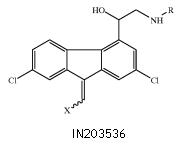
Novartis has received an Indian Patent Number 203536 (the ‘536 patent) titled Benflumetol derivatives against its patent application numbered IN/PCT/2000/884/CHE via PCT national phase. The ‘536 patent is directed to compound of formula I claiming priority from Swiss Patent Application No. 1351/98 dated June 25, 1998. The ‘536 patent is a mail-box application filed under section 5(2) of the Patents Act, 1970 which was later deleted by the Patents (Amendment) Act, 2005. The application for the ‘536 patent entered Indian national phase via International Application No. PCT/EP1999/004355 filed June 23, 1999 and published as WO1999/067197 dated December 29, 1999. The ‘536 patent is Indian equivalent of the U.S. Patent No. 6,329,552.
Merckle receives Indian Patent for 4-Pyridyl-and 2, 4-pyrimidinyl-substituted pyrrole derivatives

German MNC --- Merckle GmbH has recently received an Indian Patent Number 203540 (the ‘540 patent) titled “4-Pyridyl-and 2, 4-pyrimidinyl-substituted pyrrole derivatives and their use in pharmacy against the Indian application number IN/PCT/2002/1337/CHE. The ‘540 patent is directed to a 4-pyridyl- or 2, 4-pyrimidinyl-substituted compound of formula I and the optical isomers, physiological tolerable salts and physiologically easily hydrolyzable esters thereof. The U.S. equivalent of the ‘540 patent --- explicitly discloses list of 24 representative compounds covered within the structural scope of general formula I (Table 1).
Patent Details
Patent Number: IN203540
Application Number: IN/PCT/2002/1333/CHE
International Filing Date: January 31, 2001
Priority Date: February 01, 2000
Priority Document: DE 100 04 157.4
Priority Country: Germany
Assignee: Merckle GmbH
U.S. Equivalent: U.S. 6,867,211
WO Publication Number: WO2001057042
Sunday, February 04, 2007
Wyeth in Trouble over Zosyn Formulation Patent

Chennai-based Orchid Chemicals & Pharmaceuticals Ltd. along with two other generic manufactures --- Sandoz and Abraxis Pharmaceutical Products sued Wyeth for unfairly delaying the entry of generic versions of blockbuster Zosyn in the US market. All three generic manufactures filed citizen petitions with the USFDA against Wyeth, after Wyeth received the U.S. Patent No. 6,900,184 (the ‘184 patent) on its blockbuster drug Zosyn, extending its patent life to 2023. U.S. Patent No. 4,562,073 (the ‘073 patent) covering tazobactam sodium, one of the key active ingredients of Zosyn will be running out patent protection on February 09, 2007. Wyeth discontinued its original formulation for Zosyn in November 2005 and subsequently launched a new patented formulation, delaying generic entry in the US market. According to the US FDA rules, a company is allowed to withdraw a product from the market only for reasons related to safety and efficacy. In case the product is withdrawn from the market, it is subsequently removed from the approved drugs’ reference list, and therefore no pharmaceutical company can market a generic version of this same drug. The generic manufactures challenged Wyeth approach, arguing that Wyeth is trying to extend the paten life of the drug and prevent the entry of generic players in the U.S. market. Generics further added while Wyeth has added an excipient to its drug, other players should be allowed to market generic versions of the original formulation for Zosyn. Orchid, Sandoz and Abraxis pharma already filed ANDAs in order to market a generic version of Zosyn’s original formulation in the U.S. The ‘184 patent particularly covers Wyeth’s re-launched Zosyn formulation comprising cryodesiccated powder of piperacillin sodium and tazobactam sodium along with edentate disodium dehydrate (EDTA) as a particulate formation inhibitor and sodium citrate as a buffer.
Saturday, February 03, 2007
GlaxoSmithKline to Seek Preliminary Injunction against Ranbaxy
Ranbaxy has received FDA final approval for its generic Valtrex on January 31, 2007 and subsequently has notified GlaxoSmithKline about its intention to market the generic Valtrex tablets in the US before expiry of the U.S. Patent No. 4,957,924 (the ‘924 patent) for which patent infringement lawsuit is pending with the district court. GlaxoSmithKline will apply to the court for a preliminary injunction prohibiting launch of Ranbaxy’s generic Valtrex pending completion of the lawsuit. Apart from Ranbaxy, Mylan also received FDA tentative approval for generic Valtrex following the expiration of ‘924 patent in 2009. Ranbaxy is the only generic manufacture to make Para IV certification for the ‘924 patent covering hydrochloride salt of L-valyl ester prodrug of acyclovir.
Under the terms of agreement between the companies, previously approved by the court, if GSK applies for such an injunction within 45 days, Ranbaxy will not launch its product until the court either rules on the preliminary injunction or decides the pending court case. However, no trial date has yet been set for this litigation.
Earlier in May 2003, GSK filed Para IV infringement lawsuit in the U.S. District Court of New Jersey against Ranbaxy alleging infringement of the ‘924 patent for Valtrex, generically known as Valacyclovir which will run patent protection till June 23, 2009.
Thursday, February 01, 2007
Court Favors Pfizer in Norvasc Patent Lawsuit
U.S. District Court for the Eastern District of Virginia has ruled in the favor of Pfizer against generic drug maker Synthon in a patent infringement case involving Pfizer’s hypertension drug Norvasc. The court found that Synthon obtain by inequitable conduct two U.S. patents alleged to cover a process and an intermediate compound used to make the amlodipine besylate. Pfizer said the court issued a ruling that Synthon knowingly withheld from the U.S. Patent Office Pfizer publications and other information that described the process for which Synthon was seeking a patent.
Subscribe to:
Comments (Atom)